Stacks
1. Overview
A stack is a data structure that uses the FILO mechanism (First In, Last Out), i.e., you only have access to the last element (top element) inserted into the stack.
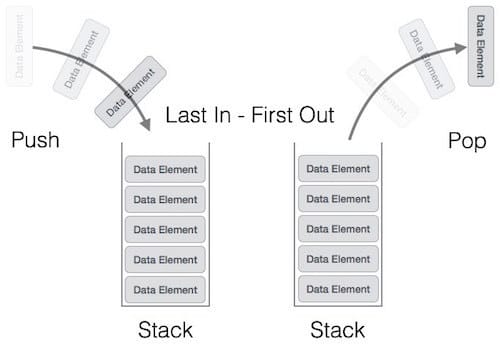
- Use Cases:
- To implement the “undo” feature in a text editor, every edition you make is pushed onto a stack. Should you want to undo it, the text editor pops an edition from the stack and reverts it.
- Stack region of memory: Used for tracking the return addresses, parameters, and local variables for subroutines.
- Tracking tokens when parsing a programming language.
2. Operations and Complexities
| Operation | Time Complexity | Notes |
|---|---|---|
| Push | O(1) | Add an element to the top of the stack |
| Pop | O(1) | Retrieve and remove the element on top of the stack |
| Top / Peek | O(1) |
More “advanced” stacks may provide more operations to check whether the stack is empty, to get the top element but don’t remove it from the stack top(), or to get the number of items currently in the stack.
Stack Implementation - Dynamic Arrays vs Linked Lists:
-
Dynamic arrays have random access to memory - which is not a huge advantage in stacks because you only care about the top element.
-
Dynamic arrays may be resized if the stack grows, meaning the elements from the old array must be copied to the new array. This resizing is a time-consuming operation.
-
Linked lists allocate memory dynamically for each new element. Depending on the overhead of the memory allocator, these allocations are often more time-consuming than the copies required by a dynamic array.
-
Adjacent elements in a dynamic array are adjacent elements in memory, and this may not be the case for linked lists. Also, a pointer is needed for each element of a linked list.
-
The prior point shows that dynamic arrays have better memory locality, which has big performance implications as processors are faster than arrays. Usually, an array-based stack is faster than a linked list.
-
Conversely, a linked list is easier to implement than a dynamic array.
5. Must-Know Problems
6. Common Mistakes / Corner Cases
- Empty stack. Popping from an empty stack.
- Stack with one item.
- Stack with two items.